
 EN
EN
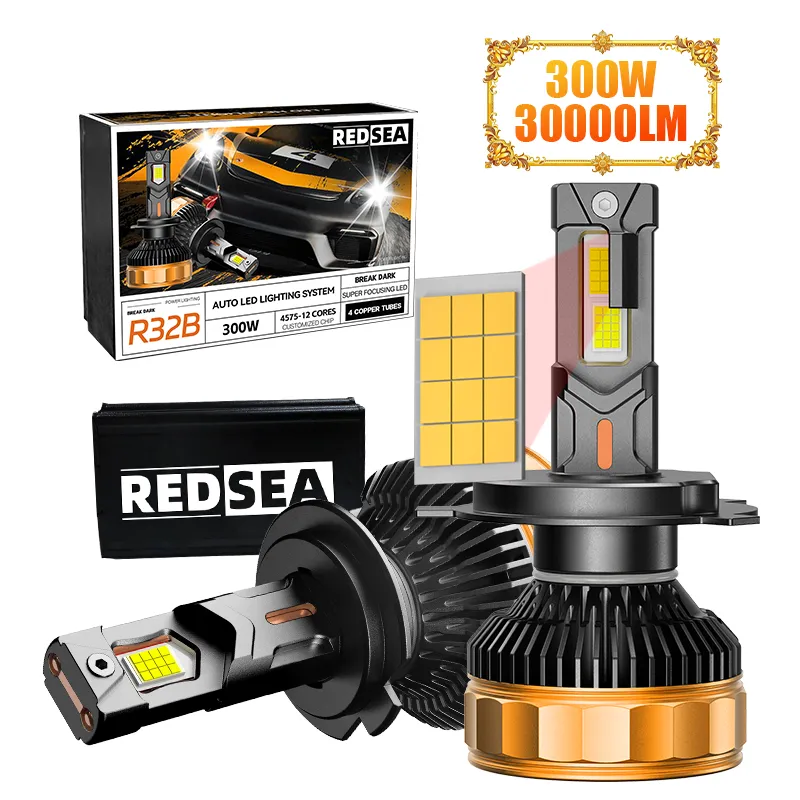
Why Truck LED Headlights Face Different Demands Than Passenger Car Units
Commercial trucks operate under conditions that passenger vehicles rarely encounter: continuous multi-hour nighttime service, severe vibration from diesel engines and rough road surfaces, exposure to rain, dust, and temperature extremes, and the need for reliable illumination across long distances on unlit highways. A standard LED headlight designed for a compact sedan will not survive these conditions. This article explains the specific design features that LED headlights for trucks must incorporate, helping fleet managers, truck owners, and repair shops evaluate products with the right engineering for heavy-duty use.
Robust Mechanical Construction for Vibration and Impact Resistance
The first design priority for LED headlights for trucks is mechanical durability. A heavy-duty truck's diesel engine generates continuous low-frequency vibration that transmits through the chassis into the headlight housing. Over thousands of operating hours, this vibration loosens solder joints, cracks circuit board traces, and dislodges LED chips from their substrates. Truck-grade LED headlights address this through several design measures: reinforced PCB substrates with thicker copper layers, conformal coating applied to circuit boards to dampen vibration and block moisture ingress, and aluminum or zinc alloy bulb bases that resist deformation under repeated thermal expansion and contraction. Manufacturing facilities such as Dongguan Tongying Technology, which holds ISO 9000 certification, implement reflow soldering processes that produce consistent solder joint quality — an important factor when those joints must endure years of truck-mounted vibration without failure.
Thermal Management Engineered for Continuous Nighttime Operation
Passenger car LED headlights typically operate in short bursts during evening commutes, with ample cooling between uses. Truck LED headlights may run continuously for eight to twelve hours through a single nighttime haul. This extended duty cycle places far greater demands on the heat dissipation system. Active fan-cooled designs common in passenger car bulbs often prove inadequate for truck applications because fan bearings wear out under continuous operation and dust ingestion eventually seizes the mechanism. Passive cooling designs using copper or aluminum fin arrays avoid mechanical failure modes entirely, but they require careful engineering to provide sufficient surface area for heat exchange within the confined space behind a truck headlight assembly. Some products in the Redsea LED series from Dongguan Tongying Technology utilize copper-based heat dissipation structures — a material choice that offers approximately 60% higher thermal conductivity than aluminum — helping to draw heat away from the LED junction efficiently during extended operation.
Beam Pattern Optimization for Elevated Mounting Height
Truck headlights are mounted significantly higher than passenger car headlights — typically 800mm to 1200mm above the road surface for heavy trucks, compared to 500mm to 700mm for most cars. This mounting height changes the optimal beam pattern geometry. LED headlights for trucks need emitter positioning that projects the beam downward enough to illuminate the road surface immediately ahead of the vehicle while still reaching far enough to provide safe stopping distance at highway speeds. An improperly designed bulb in a truck housing may create a beam that peaks too far forward, leaving the area 10 to 30 meters ahead of the truck dangerously under-lit. Buyers evaluating LED headlights for trucks should look for bulbs with chip positioning specifically engineered to account for the housing height of commercial vehicles, rather than assuming that a bulb that performs well in a car will produce the same results in a truck.
Dual-Voltage Compatibility for 12V and 24V Electrical Systems
While most passenger vehicles operate on 12V electrical systems, many medium-duty and heavy-duty trucks worldwide use 24V systems — particularly in Europe, Asia, and markets influenced by Japanese commercial vehicle standards. An LED headlight designed only for 12V input will fail immediately or rapidly overheat when connected to a 24V system. Truck-specific LED headlights must incorporate wide-voltage driver circuitry, typically rated for 9V to 32V operation, to safely handle both 12V and 24V electrical environments without requiring external voltage converters. This dual-voltage capability also provides headroom for the voltage spikes common in truck electrical systems during engine start-up and alternator load dumps, where voltage can momentarily exceed 30V.
Weather Sealing and Environmental Protection
Truck headlight housings experience more aggressive environmental exposure than passenger vehicles: pressure washing with high-pressure water jets during fleet cleaning, road salt spray in winter conditions, heavy rain at highway speeds, and fine dust ingress during off-road or construction site operation. LED headlights for trucks need meaningful IP (Ingress Protection) ratings, with IP65 or IP67 being common expectations for the bulb body and its connector interface. Beyond the rating label, effective weather sealing in practice requires quality control during manufacturing — properly seated O-rings, uniform application of sealing compounds around wire entries, and connector designs that prevent water from wicking along the wiring harness into the bulb. Buyers sourcing from manufacturers with documented production quality systems, such as those holding RoHS certification for material compliance and ISO 9000 for process management, gain an additional layer of confidence in the consistency of these sealing measures across production batches.
Application Example: Evaluating Truck LED Headlights for a Regional Fleet
Consider a regional freight fleet operating 15 heavy trucks on overnight routes through mountainous terrain. The fleet manager needs LED headlights for trucks that meet several concurrent requirements: 24V electrical system compatibility, continuous 10-hour nighttime operation cycles, exposure to temperatures ranging from -15°C in winter to 45°C in summer, and beam patterns suitable for winding mountain roads where the road surface immediately ahead must remain well-lit during tight turns. The evaluation process involved requesting photometric test data at multiple distance points, reviewing supplier aging test results for 2,000-hour continuous operation, and physically inspecting heat sink construction quality on pre-production samples. The selected product — a 330W LED bulb with copper-based passive cooling, wide-voltage circuitry, and multi-point chip placement — was installed across the fleet with zero failures reported during the first six months of service.
Table of Contents
- Why Truck LED Headlights Face Different Demands Than Passenger Car Units
- Robust Mechanical Construction for Vibration and Impact Resistance
- Thermal Management Engineered for Continuous Nighttime Operation
- Beam Pattern Optimization for Elevated Mounting Height
- Dual-Voltage Compatibility for 12V and 24V Electrical Systems
- Weather Sealing and Environmental Protection
- Application Example: Evaluating Truck LED Headlights for a Regional Fleet