
 EN
EN
Understanding the Safety Role of High Beam Headlights on Unlit Roads
Driving on dark highways without adequate high beam illumination presents one of the most dangerous scenarios a motorist can face. According to traffic safety research, the risk of a fatal crash at night is approximately three times higher than during daylight hours when adjusted for traffic volume. The high beam function is designed to extend the driver's visible range to 150 meters or more, providing the preview time needed to identify obstacles, wildlife, pedestrians, and road curvature changes at highway speeds. LED high beam headlights have introduced several characteristics that improve upon traditional halogen high beams in ways directly relevant to nighttime safety. This article examines how these technical features translate into practical safety benefits.
Extended Beam Throw Distance and the Physics of Reaction Time
The most fundamental safety contribution of LED high beam headlights is their ability to project usable illumination further down the road than halogen equivalents. At a highway speed of 100 km/h, a vehicle covers approximately 28 meters per second. The standard halogen high beam reaches roughly 100 meters of effective illumination, giving the driver about 3.5 seconds of preview time — barely adequate for a full emergency stop. Higher-output LED high beam headlights, such as 300W to 330W rated bulbs from manufacturers like Dongguan Tongying Technology, extend effective reach to approximately 150 to 180 meters under optimal conditions. This additional 50 to 80 meters of visibility adds nearly two seconds of reaction time, which can make the difference between stopping safely and colliding with an obstacle. The key technical factor is not wattage alone but luminous efficacy and beam focus — how efficiently electrical power converts to light and how precisely that light is directed onto the road surface rather than scattered upward.
Color Temperature, Contrast Perception, and Eye Fatigue Reduction
LED high beam headlights typically operate at color temperatures between 5000K and 6500K, producing a cool white light that more closely resembles natural daylight than the warm 3000K to 3500K output of halogen bulbs. This color temperature shift has two safety implications. First, the human eye's contrast sensitivity peaks under daylight-spectrum illumination, making it easier to distinguish dark objects — animals, debris, unlit vehicles — against the road surface. Second, cool white light reduces the eye fatigue associated with prolonged nighttime driving under warm yellow illumination, which can cause the visual system to strain in an effort to resolve details. For long-haul truck drivers and overnight travelers who spend hours on dark highways, this reduction in visual fatigue contributes to sustained alertness and better hazard recognition throughout the journey.
Beam Pattern Uniformity and Reduced Dark Spots
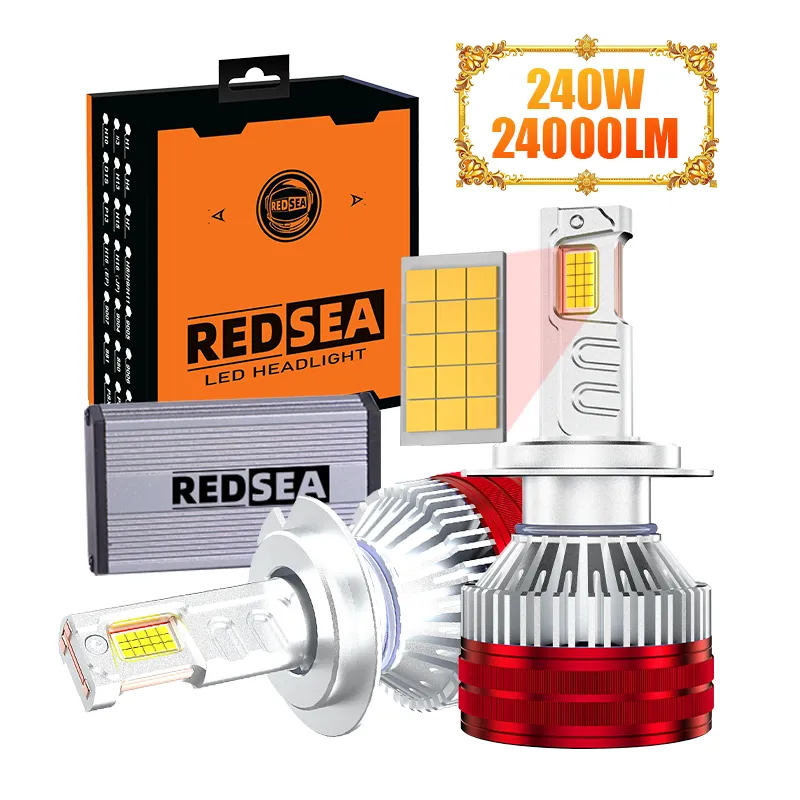
The physical structure of a halogen filament produces light from a coiled wire that emits in all directions, requiring precise reflector geometry to shape the beam. Slight manufacturing variations in filament position create dark spots and uneven illumination patterns. LED high beam headlights with multi-point chip placement, such as those found in the Redsea series produced by Dongguan Tongying Technology, position individual LED emitters along the bulb shaft at locations that correspond to the focal points of the headlight reflector. This design approach produces a more uniform beam pattern with fewer dark gaps across the illuminated field. On dark highways, beam uniformity directly affects safety: a dark spot in the high beam pattern can hide a deer standing on the road shoulder or a pedestrian crossing at the edge of the beam, while a uniform spread reveals these hazards across the full width of the illuminated zone.
Instant Full-Brightness Activation and Flashing Communication
Halogen high beam bulbs require approximately 200 to 300 milliseconds to reach full brightness after activation because the tungsten filament must heat to operating temperature. LED high beam headlights achieve full brightness within microseconds of receiving current — effectively instant activation. While this difference may seem marginal, it matters in two scenarios. First, when a driver switches rapidly between low and high beams on winding roads, the instantaneous response of LED high beams eliminates the brief dark interval that occurs during halogen bulb warm-up, maintaining continuous road illumination during the transition. Second, the high beam flash function — used to signal other drivers of hazards or to request right-of-way — is visibly sharper and more noticeable with LED high beam headlights, improving the effectiveness of this communication method on dark roads where hand signals and horn alerts may not carry effectively.
Reduced Power Draw and Electrical System Stability
LED high beam headlights draw significantly less current than halogen bulbs for a given level of light output. A pair of 55W halogen high beam bulbs consumes approximately 9 amps at 12V, whereas LED bulbs producing comparable or greater light output may draw 2.5 to 4 amps per bulb. This reduced electrical load has a safety implication for vehicles operating on dark highways: lower current draw means less voltage drop through aging wiring harnesses and connectors, resulting in more consistent headlight output that does not dim when other electrical accessories activate. For older vehicles with original wiring not designed for high-output lighting upgrades, LED high beam headlights place less stress on the electrical system, reducing the risk of fuse failures or wiring overheating during extended nighttime driving.
Practical Safety Scenario: Mountain Highway Night Driving
Consider a driver navigating an unlit mountain highway in the early morning hours. The road features tight curves with limited forward visibility, occasional fog pockets in low-lying sections, and wildlife crossings common in forested stretches. Under halogen high beams, the effective illumination range of approximately 100 meters provides roughly 3.5 seconds to react at 100 km/h, with the warm yellow light offering limited contrast for dark-colored animals against the road surface. After upgrading to LED high beam headlights rated at 300W with 6000K color temperature and multi-point chip placement, the driver experiences approximately 160 meters of useful high beam throw — about 5.7 seconds of reaction time. The cooler white light improves animal detection contrast, and the uniform beam pattern eliminates the dark wedge that previously concealed the road shoulder on tight curves. While no lighting upgrade eliminates all nighttime driving risks, the extended preview time and improved contrast directly address the two factors most correlated with single-vehicle nighttime crashes: insufficient reaction distance and failure to detect roadside hazards.
Table of Contents
- Understanding the Safety Role of High Beam Headlights on Unlit Roads
- Extended Beam Throw Distance and the Physics of Reaction Time
- Color Temperature, Contrast Perception, and Eye Fatigue Reduction
- Beam Pattern Uniformity and Reduced Dark Spots
- Instant Full-Brightness Activation and Flashing Communication
- Reduced Power Draw and Electrical System Stability
- Practical Safety Scenario: Mountain Highway Night Driving