EN
EN
Quick Links
Introduction
Most car owners believe LED headlights are immune to seasonal weather changes, delivering consistent brightness year-round. In reality, extreme summer heat and freezing winter cold are two of the biggest invisible threats to automotive LED lighting. Ambient temperature directly impacts LED luminous efficiency, circuit stability, heat dissipation performance, and long-term service life.
Professional test data shows that when the ambient temperature rises from 30°C to 60°C in summer, LED high-beam illuminance can drop by up to 21.7%, while low-beam brightness decreases by 16.6%. In frigid winter conditions below -20°C, generic LED bulbs often suffer from startup delay, flickering, and abnormal color tone deviation. Seasonal temperature swings are the core cause of premature LED light decay, intermittent failure, and performance inconsistency.
This SEO-focused guide professionally compares summer heat damage and winter cold damage to LED headlights, analyzes different failure mechanisms in high-temperature and low-temperature environments, summarizes practical seasonal maintenance tips, and explains how REDSEA’s full-temperature precision design achieves stable all-season LED lighting performance without brightness attenuation or failure.
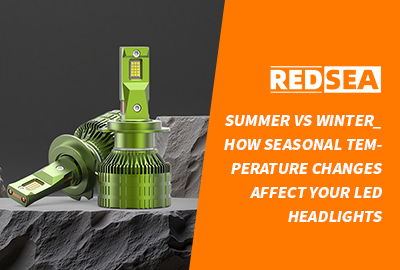
1. How Summer High Temperatures Degrade LED Headlight Performance
Summer is the peak season for LED headlight aging and luminous decay. After long-time sunlight exposure, the enclosed headlight cavity can reach 55°C–65°C. Combined with heat generated by LED chips during operation, bulbs work in ultra-high temperature environments for hours, triggering multiple performance losses.
Core Summer Performance Losses
2. How Winter Low Temperatures Affect LED Headlight Operation
LED chips are far more cold-resistant than traditional halogen filaments, but extreme freezing weather still challenges low-quality LED bulbs. In low-temperature environments of -20°C to -30°C, the structural stability and circuit response of ordinary LED products drop significantly, bringing unique winter failure symptoms.
Core Winter Performance Losses
3. Summer vs Winter LED Damage: Key Differences
Seasonal temperature changes lead to completely different failure modes and performance losses. Summer heat causes permanent aging and brightness attenuation, while winter cold mainly triggers temporary unstable operating states.
|
Comparison Item |
High-Temperature Summer Impact |
Low-Temperature Winter Impact |
|
Main Damage Type |
Permanent luminous decay, component aging |
Temporary startup instability, signal fluctuation |
|
Brightness Change |
Sustained decline, irreversible |
Stable after warm-up, no permanent loss |
|
Core Failure Manifestation |
Dim illumination, light shift, overheat dimming |
Startup delay, cold flicker, temporary color deviation |
|
Long-Term Impact |
Shorten overall bulb service life severely |
No obvious aging damage, only temporary instability |
4. Practical All-Season LED Headlight Protection Tips
Targeted seasonal maintenance can effectively avoid temperature-induced performance attenuation and extend LED bulb service life:
5. REDSEA All-Temperature Precision Design: Stable Performance in Summer Heat & Winter Cold
Aiming at seasonal temperature failure pain points of ordinary LED bulbs, REDSEA adopts industrial-grade full-temperature range adaptive design, perfectly adapting to -30°C extreme cold to +85°C high-temperature environments. It solves summer heat aging and winter cold instability simultaneously, achieving truly year-round stable lighting.
Conclusion
Seasonal temperature changes bring completely different damage mechanisms to LED headlights: summer high temperature causes permanent light decay and aging, while winter low temperature leads to temporary startup and circuit instability. Ordinary generic LED bulbs cannot adapt to extreme seasonal temperature differences, resulting in attenuated lighting performance and frequent failures throughout the year.
REDSEA industrial-grade LED headlights rely on full-temperature range adaptive precision design and systematic heat dissipation optimization, breaking seasonal performance limitations. It maintains consistent high brightness, standard beam, and stable operation in both hot summer and cold winter environments, providing global users with reliable all-season night driving lighting protection.

Dongguan Red Sea Technology Development Co., Ltd. provides premium LED car headlights, BI-LED & laser lenses for global automotive brands. 15+ years OEM/ODM expertise, strict QC, 2000+ distributors. Contact us today!
Room 501, Building 1, No. 8 Chuangyi East Road, Daojiao Town, Dongguan City, Guangdong Province,523000
Copyright © 2026 by Dongguan Red Sea Technology Development Co., Ltd. Privacy Policy
 Hot News