
 EN
EN
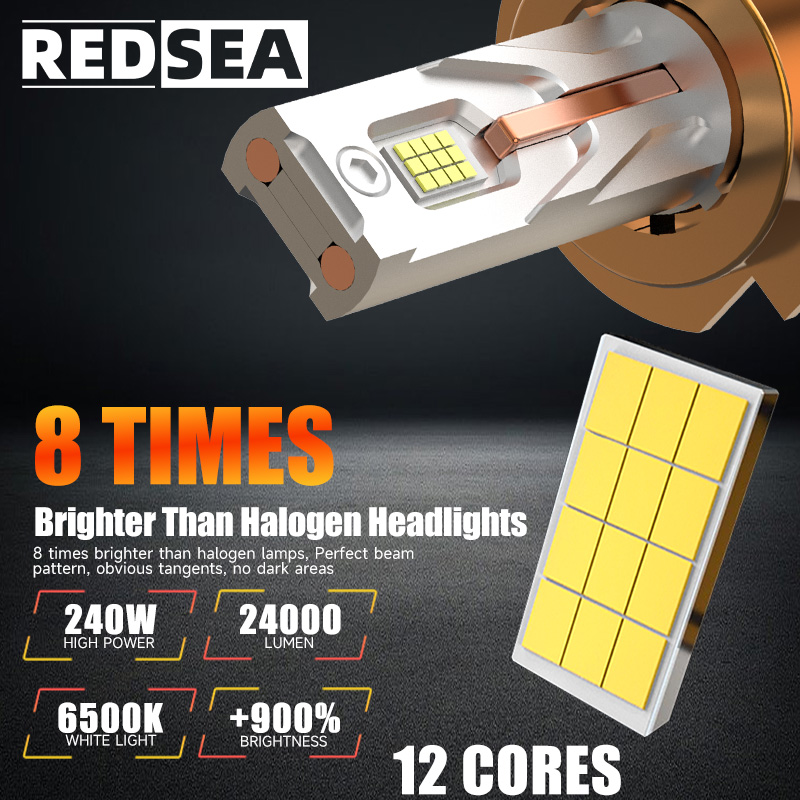
Understanding Why Commercial Vehicles Use 24V Electrical Systems
Commercial vehicles operate on 24V electrical systems rather than the 12V systems found in passenger cars, and this voltage difference has direct implications for LED headlight selection. The LED H4 24V bulb is specifically engineered to function within the 24V power architecture commonly found in heavy-duty trucks, buses, and construction equipment. The reason commercial vehicles use 24V systems is practical: doubling the voltage halves the current required for the same power output, which allows thinner wiring, reduces voltage drop over long chassis distances, and decreases heat generation in the electrical harness. For a headlight drawing 55 watts, a 12V system carries approximately 4.6 amps, while a 24V system carries only 2.3 amps. This lower current load is essential for vehicles with extended wiring runs from the battery to the front grille — distances that can exceed 8 meters in a semi-trailer truck.
Heavy-Duty Trucks and Semi-Trailer Tractors
Heavy-duty trucks and semi-trailer tractors represent the largest category of commercial vehicles using LED H4 24V headlights. These vehicles, including models from manufacturers such as Sinotruk, FAW, Dongfeng, Shacman, and European brands like Scania and MAN, typically feature H4 dual-beam headlight sockets in their main driving lamp assemblies. The H4 configuration is preferred because it combines high beam and low beam in a single bulb, simplifying replacement and reducing the number of spare parts a fleet must carry. For long-haul trucking fleets that operate across varying road conditions — from well-lit highways to unlit rural routes — the LED H4 24V bulb provides significantly higher luminous flux than the halogen equivalent, improving driver visibility and reducing eye fatigue during night shifts that can last 8 to 12 hours. The 24V LED driver is designed to handle the voltage fluctuations common in truck electrical systems, where starter motor engagement can momentarily depress system voltage to 18V or spike to 28.8V during alternator charging.
Buses and Coaches
City buses, intercity coaches, and school buses constitute another major category of commercial vehicles that commonly use LED H4 24V headlights. Public transit buses from manufacturers such as Yutong, King Long, and Golden Dragon frequently use H4 sockets in their front lighting assemblies. For urban bus fleets, the transition from halogen to LED H4 24V bulbs offers two specific advantages: reduced maintenance frequency (LED bulbs last significantly longer than halogen, minimizing downtime for bulb changes in high-utilization fleets) and improved light quality for navigating poorly lit bus stops and depots during early morning and late evening shifts. Intercity coaches that travel on highways at night benefit from the extended range and sharper cutoff pattern of LED headlights, which enhance the driver's ability to detect obstacles and pedestrians at greater distances. The 24V specification is standard for bus electrical systems, and using a bulb specifically rated for 24V prevents the premature driver failure that occurs when 12V LED bulbs are incorrectly installed in 24V vehicles.
Construction and Mining Equipment
Excavators, wheel loaders, bulldozers, and mining haul trucks represent a specialized but significant segment of LED H4 24V headlight users. These machines operate in harsh environments characterized by intense vibration, dust, mud, and extreme temperature variations. The H4 socket is commonly found in auxiliary driving lights and work lights on construction equipment, where the dual-beam functionality allows operators to switch between a wide flood pattern for close-range work and a focused spot beam for illuminating distant hazards. For mining applications, the LED H4 24V bulb must meet additional requirements beyond standard automotive specifications: high ingress protection ratings (IP67 or above) to withstand water jet cleaning and mud immersion, vibration resistance to endure the constant shock of off-road operation, and thermal stability in ambient temperatures that can exceed 50 degrees Celsius in open-pit mines. Dongguan Tongying Technology produces LED H4 24V variants with aluminum housings and sealed driver modules designed to withstand the mechanical and environmental stresses typical of construction and mining applications.
Agricultural Tractors and Farm Equipment
Modern agricultural tractors and self-propelled farm machinery also use 24V electrical systems with H4 headlight sockets. Tractors from brands such as John Deere, Massey Ferguson, and domestic Chinese manufacturers like LOVOL and Dongfeng Agricultural Machinery often operate during early morning and late evening hours during planting and harvest seasons. The LED H4 24V bulb is particularly valuable in agricultural applications because the vibration from diesel engines and rough field terrain can shorten halogen bulb life dramatically — sometimes to less than 200 hours. LED bulbs, with no fragile filament, are inherently more resistant to vibration-induced failure. Additionally, the color temperature of LED headlights (typically 6000K) provides better contrast for detecting rocks, ditches, and field boundaries compared to the warm yellow light of halogen bulbs (3000K-3200K). For farm equipment that may sit idle for months between seasons, the long shelf life and instant-on characteristic of LED technology reduce the likelihood of discovering a failed bulb at the start of a critical harvest period.
Case Study: Fleet Upgrade from Halogen to LED H4 24V in a Regional Logistics Company
A regional logistics company operating a mixed fleet of 45 heavy-duty trucks (Sinotruk Howo and Dongfeng Tianlong models) and 12 intercity buses evaluated the transition from halogen H4 24V bulbs to LED H4 24V alternatives. The primary motivation was reducing the frequency of bulb replacements — the fleet was replacing halogen bulbs an average of every 4 to 6 months due to vibration-induced filament failure on rough regional roads. After sourcing LED H4 24V samples rated at 80W per pair with a claimed luminous flux of 16,000 lumens, the company conducted a three-month trial on 10 trucks and 4 buses. Results showed: zero bulb failures during the trial period, driver-reported improvement in night driving visibility (particularly on unlit highway sections), and no CAN bus error messages on any test vehicle. The company subsequently rolled out the LED upgrade across the entire fleet, projecting a payback period of approximately 14 months based on reduced bulb purchase costs and decreased labor time for replacements. The fleet manager noted that sourcing from a manufacturer with ISO 9000-certified production — such as Dongguan Red Sea Technology — provided additional confidence in product consistency across large-quantity orders.
Key Specifications to Verify When Purchasing LED H4 24V Bulbs
When sourcing LED H4 24V headlights for commercial vehicle fleets, buyers should verify several critical specifications beyond the basic H4 socket and 24V rating. The input voltage range should accommodate the full operating spectrum of commercial vehicle electrical systems — ideally 18V to 36V — to handle startup voltage sag and alternator charging spikes. The IP rating should be at least IP65 for standard truck applications and IP67 for construction and mining equipment. The operating temperature range should span from -40 degrees Celsius to at least 85 degrees Celsius to cover winter and summer extremes. The luminous flux should be verified through photometric test reports rather than manufacturer claims alone, and the beam pattern should be tested on the actual vehicle housing to confirm proper cutoff and light distribution. Finally, for fleet buyers placing bulk orders, requesting aging test data from the manufacturer helps confirm that the production batch meets consistent quality standards before committing to a full fleet rollout.
Frequently Asked Questions
Q: Can I use a 12V LED H4 bulb in a 24V commercial vehicle?
A: No. A 12V LED bulb connected to a 24V system will experience immediate driver failure due to overvoltage. Always use LED H4 24V bulbs specifically rated for 24V commercial vehicle electrical systems.
Q: What is the typical lifespan of an LED H4 24V bulb in a heavy truck?
A: Under normal operating conditions with proper voltage regulation and adequate heat dissipation, an LED H4 24V bulb should last 30,000 to 50,000 hours. In high-vibration commercial vehicle applications, actual lifespan may be somewhat shorter but still significantly exceeds halogen bulb life.
Q: Do LED H4 24V bulbs require Canbus decoders for commercial vehicles?
A: It depends on the vehicle. Older truck models with relay-based lighting circuits do not require Canbus decoders. Newer trucks with CAN bus electrical monitoring may need Canbus-compatible LED H4 24V bulbs to prevent dashboard error messages.
Table of Contents
- Understanding Why Commercial Vehicles Use 24V Electrical Systems
- Heavy-Duty Trucks and Semi-Trailer Tractors
- Buses and Coaches
- Construction and Mining Equipment
- Agricultural Tractors and Farm Equipment
- Case Study: Fleet Upgrade from Halogen to LED H4 24V in a Regional Logistics Company
- Key Specifications to Verify When Purchasing LED H4 24V Bulbs
- Frequently Asked Questions
