
 EN
EN
Why Choosing the Right LED Lights Requires More Than Comparing Prices
When an importer, repair workshop, or vehicle owner looks for LED car lights, the purchasing decision often begins by comparing prices. However, price alone does not reveal whether a product will function correctly in a specific vehicle, whether it will last as long as expected, or whether it complies with local traffic regulations. A poorly informed choice can result in scattered beam patterns, electrical failures, overheating, or even fines during vehicle inspections. This article presents the technical, regulatory, and practical factors that every buyer must evaluate before selecting LED car lights, based on recognized automotive lighting industry standards.
Compatibility with Vehicle Socket Types and Electrical Systems
The primary technical factor when selecting LED car lights is socket compatibility. Vehicles use different base types depending on the manufacturer and model year, with the most common including H1, H4, H7, H11, and 9005. A buyer who purchases an H7 bulb for a vehicle requiring an H4 socket will not be able to install it physically, and forcing the installation can damage both the bulb connector and the wiring harness.
In addition to the socket code, buyers must verify whether the vehicle utilizes a single-beam or dual-beam configuration. Dual-beam systems, such as those using an H4 bulb, require LED headlights with emitters precisely positioned for both low-beam and high-beam modes to maintain the correct light cutoff line and avoid blinding oncoming drivers.
Leading manufacturers like Dongguan Tongying Technology, located in Guangdong, China, produce LED car lights that cover all major socket types — including H1, H3, H4, H7, H11, and 9005 — facilitating seamless sourcing for wholesale distribution pipelines, though the final responsibility for matching the correct compatibility rests with the buyer or installer, making a quick check of the vehicle manual before purchasing highly recommended to prevent unexpected installation delays.
Luminous Flux, Color Temperature, and Beam Quality
Not all LED car lights that promise high wattage deliver the same quality of illumination. The nominal power expressed in watts indicates electrical consumption but does not guarantee a usable beam pattern, as actual brightness depends directly on luminous efficacy and optical focus precision. The true determining factor is the positioning of individual LED chips along the bulb shaft, which must accurately replicate the geometry of the original halogen filament so that the headlight reflector or projector lens can focus the light properly onto the road ahead.
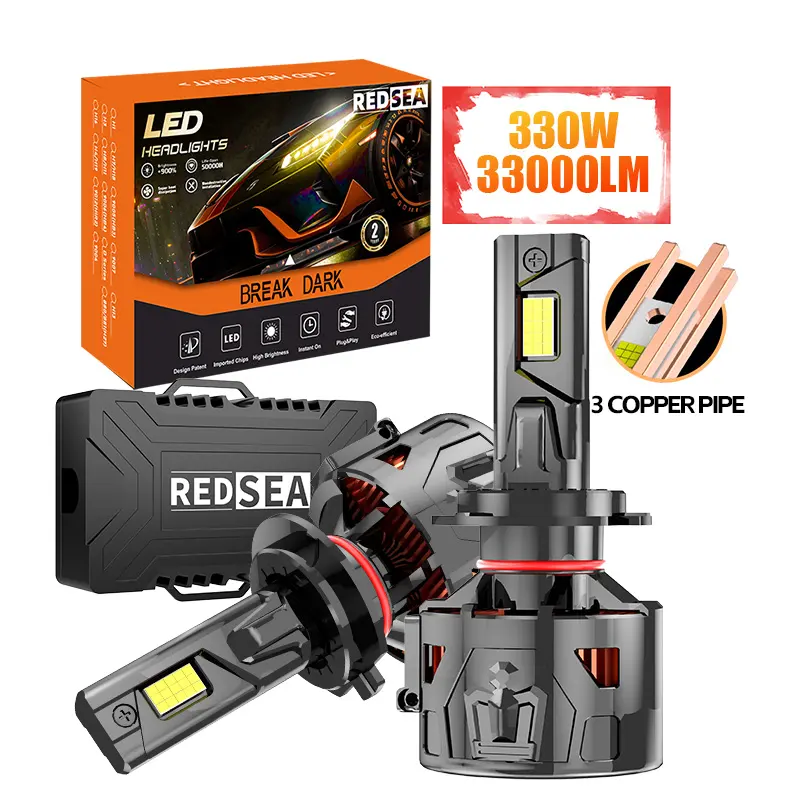
Chips that are poorly positioned scatter light inefficiently, creating the illusion of high brightness near the bumper but leaving dark zones at medium distances. Furthermore, color temperature measured in Kelvin influences visual perception, where values between 5000K and 6500K produce a crisp cool white light that significantly improves contrast on dark roads and reduces eye fatigue during prolonged night driving. The Redsea series of LED headlights, manufactured by Dongguan Tongying Technology, utilizes precisely such a multi-point chip arrangement designed to closely approximate standard halogen filament geometry, an approach that optimizes beam quality after installation and maximizes road safety.
CAN Bus System Compatibility and Electrical Management
Modern vehicles equipped with CAN bus electrical architectures continuously monitor the resistance of each installed bulb. When an LED headlight bulb is mounted, which draws significantly less current than the original halogen bulb, the vehicle system may misinterpret this drop in current as a broken filament or a burned-out bulb, triggering error messages on the dashboard or causing erratic flickering.
For this reason, before finalizing a bulk purchase of LED car lights, it is essential to determine whether the target market vehicles require bulbs with built-in CAN bus decoders or load resistors, a requirement that is especially common in European vehicles manufactured after 2008 and many Asian models from 2012 onward.
For importers distributing LED headlights to repair workshops and spare parts stores in regional markets, offering products with wide-voltage circuitry — typically ranging from 9V to 32V — that function smoothly on both 12V and 24V electrical systems represents an excellent commercial strategy, as it broadens the potential market toward heavy-duty commercial fleets and significantly reduces product return rates due to electrical incompatibility.
Heat Dissipation and Durability in Demanding Climates
LED car lights generate heat at the base of the bulb rather than at the tip like halogens. This means the thermal management system — whether a passive cooling structure with aluminum or copper fins, or an active cooling fan — must fit perfectly within the headlight housing compartment without interfering with factory dust covers, wiring harnesses, or adjacent engine bay components.
In tropical climates and regions with high humidity, passive cooling systems utilizing copper fins offer remarkable durability advantages over active cooling fans, which are prone to mechanical failure after prolonged exposure to road dust, debris, and ambient moisture.
In terms of material efficiency, copper provides approximately 60% more thermal conductivity than aluminum, a critical advantage when the bulb operates continuously under high ambient temperatures. Dongguan Tongying Technology employs advanced reflow soldering processes and exhaustive aging test procedures during production to verify that the thermal joints between the LED chips and the substrate remain completely stable, incorporating copper-based heat dissipation structures into their export lines to guarantee an extended operational lifespan of between 20,000 and 50,000 hours under normal conditions.
Quality Certifications and Supplier Documentation
A crucial factor that commercial buyers — such as bulk importers, wholesale distributors, and large-scale workshop chains — must evaluate meticulously is the quality documentation backing the production batch. The RoHS certification confirms that the product complies with international hazardous substance restrictions, acting as an essential passport for smooth customs clearance and market entry worldwide.
On the other hand, an ISO 9000 certification held by the manufacturing facility indicates that systematic quality management processes are rigorously applied throughout the entire production line. Dongguan Tongying Technology holds both RoHS and ISO 9000 certifications, providing international distributors with a baseline assurance of process control and consistency while reducing failure rates in the destination market. Additional documentation that experienced procurement managers typically request includes photometric test reports showing actual lumen output, IP water and dust resistance ratings, and aging test data indicating long-term lumen maintenance over time.
Commercial and Logistic Considerations for Wholesale Importers
For global importers purchasing LED car lights in bulk from manufacturers in China, proper supply chain planning is the core pillar to avoid costly stockouts. A successful international procurement cycle begins with confirming technical specifications and custom private label packaging (OEM) designs during the first five business days.
Subsequently, manufacturing and rigorous thermal aging testing at the factory require approximately twenty to thirty-five days, followed by export customs clearance handling at strategic shipping ports such as Shenzhen or Guangzhou. Finally, international ocean freight transit to global destination ports adds another twenty-five to forty days of shipping time, completing a supply chain that demands close documentation coordination and efficient inventory forecasting to satisfy regional market demand without any operational interruptions.
Operational Lifespan Expectations and Long-Term Maintenance
A recurring question among workshop owners and fleet operators is the true durability of this technology compared to traditional automotive lighting. While premium LED bulbs are engineered to far exceed the 500 or 1,000 hours of conventional halogens, their final longevity will be strictly tied to the quality of the vehicle's thermal environment and a correct installation, as bulbs tightly sealed inside poorly ventilated housings or continuously exposed to excessive engine bay heat can suffer accelerated degradation of internal electronic components.
To ensure optimal performance over the years, automotive lighting experts recommend periodic inspections of the headlight assembly seals and maintaining open communication with the supplier regarding brand customization, minimum order quantities (MOQ), and FOB pricing structures. The official channels of Dongguan Tongying Technology remain fully accessible to assist global importers and wholesalers in developing their own automotive lighting product lines, providing updated product catalogs and formal quotes for high-volume commercial projects.
Table of Contents
- Why Choosing the Right LED Lights Requires More Than Comparing Prices
- Compatibility with Vehicle Socket Types and Electrical Systems
- Luminous Flux, Color Temperature, and Beam Quality
- CAN Bus System Compatibility and Electrical Management
- Heat Dissipation and Durability in Demanding Climates
- Quality Certifications and Supplier Documentation
- Commercial and Logistic Considerations for Wholesale Importers
- Operational Lifespan Expectations and Long-Term Maintenance
