EN
EN
Quick Links
Introduction
Installing brand-new LED headlight bulbs is supposed to upgrade your night driving with brighter, clearer, and longer-lasting illumination. However, many car owners encounter a frustrating issue right after replacement: continuous flickering, intermittent strobing, startup flash, or even dashboard warning errors. Most users immediately assume the new LED bulbs are defective and rush to replace them, yet the problem persists.
In fact, over 80% of LED headlight flickering issues are not caused by faulty bulbs. They stem from circuit matching conflicts, system monitoring mechanisms, unstable power supply, or improper installation. This SEO-focused guide breaks down the real root causes of LED headlight flickering, distinguishes avoidable operational errors from inherent system incompatibility, and shares professional solutions. We also explain how REDSEA’s precision circuit design and full-decoding structure completely eliminate flickering and error code troubles for stable long-term lighting performance.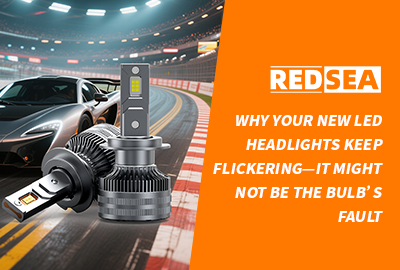
1. The No.1 Cause: CANBUS System Load Detection Mismatch
Modern vehicles are equipped with intelligent CANBUS circuit monitoring systems that continuously detect the power load of lighting components. Standard halogen bulbs consume 50–55W of power, while high-efficiency LED bulbs only draw 20–30W under normal operation.
After upgrading to low-power LED bulbs, the vehicle’s detection system identifies the reduced current load as an abnormal circuit state, misjudging it as a burned-out bulb or loose connection. To confirm the fault, the system repeatedly outputs pulsed current, resulting in visible light flickering, intermittent flashing, or persistent dashboard warning prompts.
This is the most common compatibility problem for LED upgrades, especially prevalent in mid-to-high-end vehicles with sensitive circuit monitoring systems. Ordinary generic LED bulbs lack optimized decoding structures and cannot adapt to intelligent system detection rules, leading to persistent flickering issues.
2. Unstable Voltage & Current Fluctuation
LED chips are far more sensitive to voltage fluctuations than traditional halogen filaments. Vehicle power systems produce unstable current output during startup, acceleration, and idle speed. Low-quality LED drive modules fail to stabilize variable voltage input, causing frequent brightness jitter and flickering.
Long-term unstable power supply not only affects lighting stability but also accelerates chip light decay, shortening the overall service life of LED bulbs. Only precision constant-current drive structures can filter circuit fluctuations and maintain steady luminous output.
3. Poor Contact & Installation Deviation
Improper manual installation is another easily overlooked cause of flickering. Inaccurate plug-in alignment, loose socket contact, dirty wiring terminals, or incomplete clamping will lead to intermittent power supply. Vibration during vehicle operation aggravates poor contact, resulting in irregular light flickering.
In addition, mismatched lamp base positioning may cause incomplete circuit conduction. Such problems are not related to bulb quality and can be completely avoided through standardized installation operations.
4. Insufficient Heat Dissipation Triggering Overheat Protection
High-brightness LED chips generate continuous heat during long-term operation. Bulbs with simple heat dissipation structures cannot export core heat efficiently, leading to rapid temperature accumulation. When the temperature exceeds the bearing threshold of the drive module, the built-in overheat protection mechanism will automatically cut and restore power intermittently, presenting obvious flickering or dimming cycles.
5. Low-Quality Drive Module Defects
The internal drive module is the core brain that controls LED bulb operation. Inferior products adopt simplified drive circuits without anti-interference and constant-current processing functions. They cannot resist vehicle circuit interference, resulting in unstable light output, frequent flickering, and random failure codes.
Practical Troubleshooting: How to Quickly Locate Flickering Causes
REDSEA Professional Solutions to Completely Avoid LED Flickering
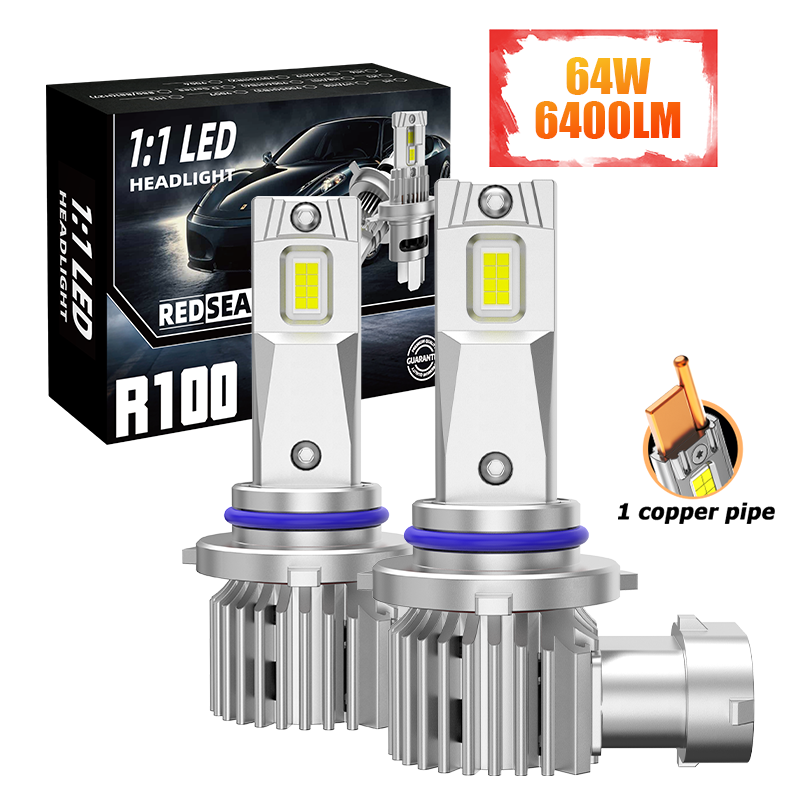
Most aftermarket LED flickering problems come from insufficient decoding capability, unstable drive output, and defective heat dissipation design. REDSEA solves these industry pain points through systematic precision hardware optimization, ensuring plug-and-play stability for global vehicle models:
Conclusion
LED headlight flickering is rarely a bulb quality defect. The core causes are mostly system compatibility mismatch, unstable power supply, improper installation, and insufficient heat dissipation design. Blindly replacing bulbs cannot solve the fundamental problem; only matching precision decoding, stable drive, and efficient heat dissipation can achieve long-term flicker-free lighting.
REDSEA professional LED headlight bulbs rely on mature circuit optimization and precision structural design to adapt to global vehicle circuit systems. They deliver stable, flicker-free, error-free, and high-brightness lighting performance, helping every user complete safe and reliable LED upgrades.

Dongguan Red Sea Technology Development Co., Ltd. provides premium LED car headlights, BI-LED & laser lenses for global automotive brands. 15+ years OEM/ODM expertise, strict QC, 2000+ distributors. Contact us today!
Room 501, Building 1, No. 8 Chuangyi East Road, Daojiao Town, Dongguan City, Guangdong Province,523000
Copyright © 2026 by Dongguan Red Sea Technology Development Co., Ltd. Privacy Policy
 Hot News