EN
Quick Links
A technical comparison and B2B sourcing guide: Base geometries (PX26d vs. PGJ19-2), electrical pinouts, beam applications (low beam, high beam, and fog), cross-compatibility facts, direct-fit LED retrofit engineering, and international regulatory compliance notices.
In the automotive aftermarket and original equipment manufacturing (OEM) sectors, headlight bulb designations often appear confusing. Among dozens of standardized bulb types, two single-beam halogen and LED sockets stand out as widespread industry standards: the H7 and the H11. Every year, millions of vehicle owners, auto parts wholesalers, and automotive lighting retrofitters encounter these two part numbers. Yet, because both are single-filament / single-beam bulbs operating on standard 12V vehicle electrical systems and delivering approximately 55 watts in stock halogen form, many drivers mistakenly assume they are interchangeable.
In reality, H7 and H11 bulbs are fundamentally different components engineered for distinct mechanical housings, mounting mechanisms, electrical connectors, and environmental sealing environments. Attempting to force an H7 bulb into an H11 socket — or vice versa — results in mechanical failure, beam misfocus, or electrical short circuits. Understanding the precise engineering distinctions between these two sockets is essential for safe driving, professional maintenance, and responsible commercial distribution.
In this comprehensive technical guide, we break down the core physical, electrical, and optical differences between H7 and H11 headlight bulbs. Furthermore, we examine direct-fit LED retrofit solutions engineered by Dongguan Red Sea Technology Development Co., Ltd. (Redsea) — such as the R200 and R300 series — demonstrating how precision optical alignment, copper-plate heat dissipation, and compact direct-fit collar designs elevate both H7 and H11 performance. Crucially, we outline the international legal framework (including ECE Regulations and E-mark requirements) to ensure commercial compliance across European and global markets.
To establish an immediate, clear overview of how these two industry-standard bulbs compare, Table 1 details the core physical, electrical, and optical specifications side by side:
| Key Parameter / Feature | H7 Headlight Bulb | H11 Headlight Bulb |
| IEC Base / Socket Type | PX26d (Flat metal mounting ring with single indexing tab) | PGJ19-2 (Plastic right-angle base with 3 locking tabs) |
| Mounting & Locking System | Pressed into housing; secured via spring wire clip or twist-lock adapter collar | Inserted and twisted 90 degrees to lock directly via 3 offset tabs |
| Connector & Pin Design | 2 exposed flat spade pins protruding straight from the base bottom | Integrated right-angle female plug with weatherpack locking latch |
| Environmental Sealing | Relies entirely on the vehicle's headlamp rubber/plastic dust cap | Self-contained rubber O-ring seal on the bulb collar (moisture/dust resistant) |
| Stock Halogen Rating | 55 Watts | ~1,500 Lumens (ECE Regulation 37) | 55 Watts | ~1,200 to 1,350 Lumens (ECE Regulation 37) |
| Typical Automotive Roles | Low Beam and High Beam (common in European & Asian passenger cars) | Low Beam (projector lenses) and Front Fog Lights (SUVs & trucks) |
| Cross-Compatibility | Incompatible with H11 (completely different base and wiring) | Incompatible with H7 (can sometimes cross-fit H8/H9/H16 with mods) |
Table 1: Technical & Functional Comparison between H7 and H11 Automotive Bulbs.
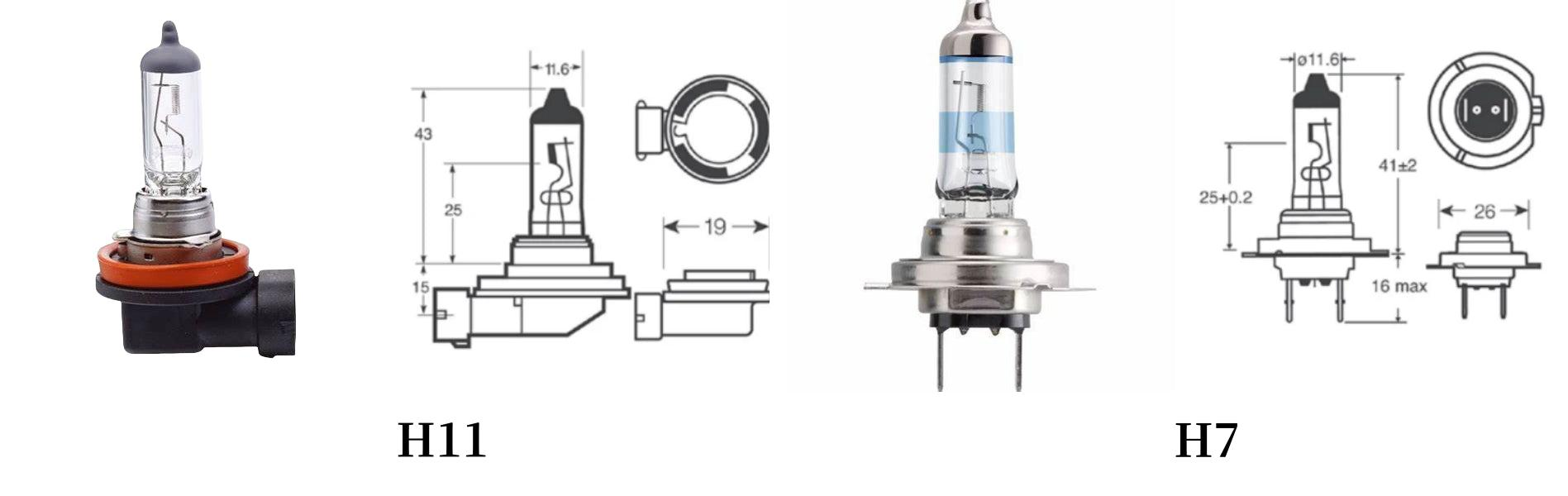
Figure 1: Direct Physical Comparison of H7 (Left: Flat Base & Two Spade Pins) and H11 (Right: Right-Angle Base with Rubber O-Ring & Three Locking Tabs).
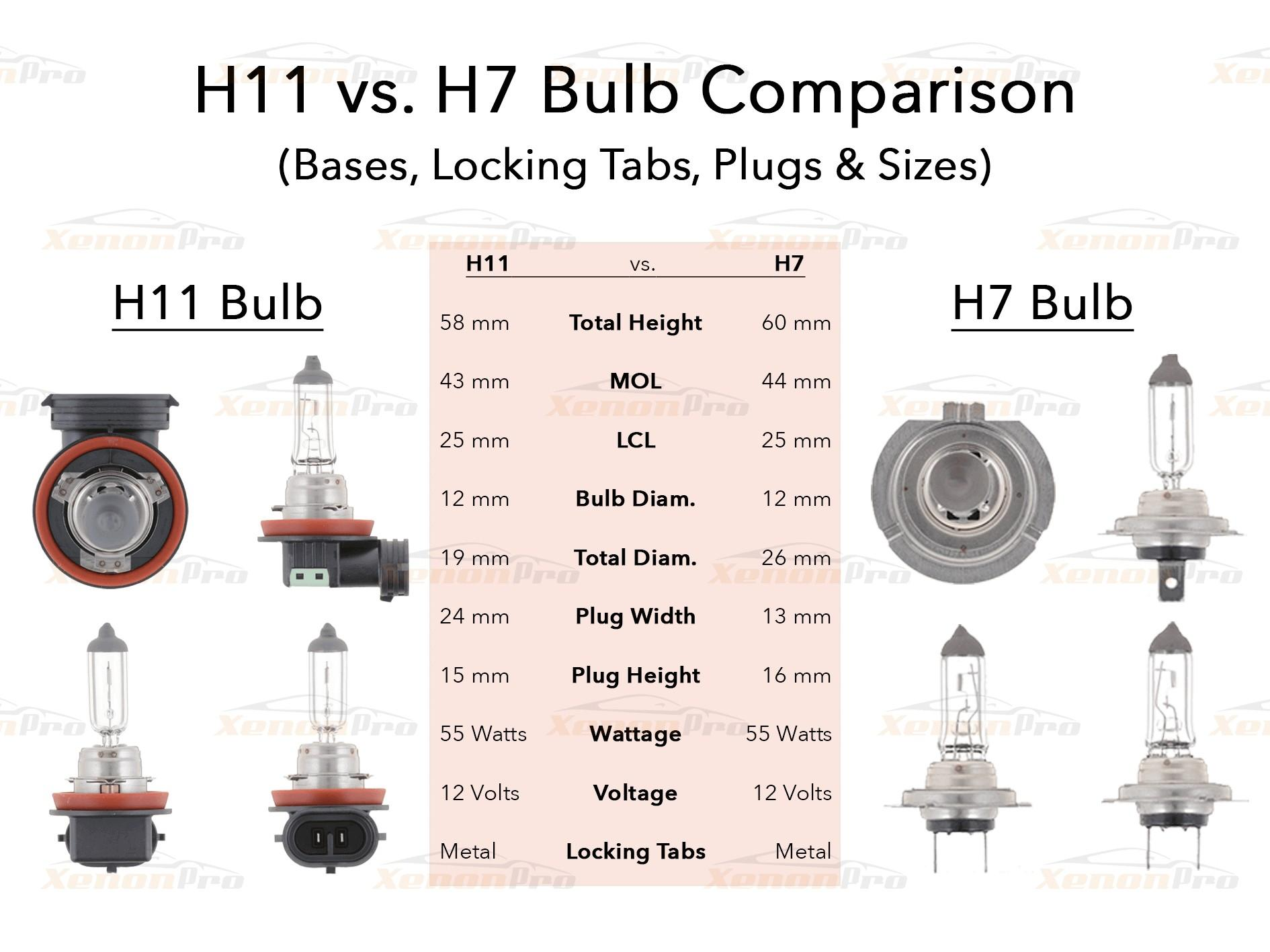
Figure 2: Dimensional and Electrical Specifications Blueprint Comparing H7 and H11 Bulb Architectures.
While both bulbs perform the same fundamental job of converting electrical energy into nocturnal road illumination, their design architectures reflect two distinct evolutionary phases in automotive lighting engineering. Below are the five critical areas where H7 and H11 diverge:
Difference 1: Base Geometry and Mounting Mechanism
The most visually obvious difference lies in how each bulb mechanically locks into the vehicle's headlamp reflector or projector housing:
• H7 (PX26d Base): The H7 utilizes a compact, flat circular metal flange with a single small alignment notch. It possesses no built-in twist tabs. To install an H7, the bulb is seated flush against the headlamp rear aperture and secured by a hinged spring-steel wire bail or a vehicle-specific twist adapter ring (common in Volkswagen, Mercedes-Benz, and BMW models).
• H11 (PGJ19-2 Base): The H11 features a molded right-angle composite base equipped with three radially spaced metal or plastic locking lugs (tabs) of varying widths. The bulb inserts directly into the housing socket and rotates roughly 90 degrees clockwise until it clicks into place. It requires no external wire retaining clips.
Difference 2: Connector Design and Environmental Sealing
Electrical connections and water resistance dictate where and how these bulbs are installed under the hood:
• H7 Connector: The H7 features two bare male spade prongs protruding directly from the rear of the metal base. The female harness connector pushes straight onto these pins. Because the pins and base are completely unsealed, H7 assemblies MUST be protected inside a weather-sealed headlamp enclosure covered by an external rubber dust cap.
• H11 Connector: The H11 incorporates an L-shaped (90-degree) socket housing with recessed electrical pins and an external snap-latch lock. Crucially, the collar features an integrated silicone O-ring gasket. When twisted into the headlight or bumper fog light housing, this O-ring compresses tightly against the aperture wall, forming an airtight and watertight seal. This makes the H11 ideal for exposed environments, such as low-mounted bumper fog lamps exposed to road splash and wheel-well spray.
Difference 3: Light Output and Filament Engineering
Under international ECE Regulation 37 and US DOT FMVSS-108 standards, stock halogen versions of both bulbs are rated at a nominal 55 watts on 12V systems (drawing approximately 4.58 amps). However, their luminous output and operational lifespan differ:
• H7 Luminous Flux: A standard halogen H7 bulb outputs approximately 1,500 lumens (±10%). Its tungsten coil is optimized for high luminous intensity, producing sharp, focused illumination ideal for high-speed forward visibility.
• H11 Luminous Flux: A standard halogen H11 bulb outputs approximately 1,200 to 1,350 lumens. It was deliberately engineered with slightly lower filament operating temperatures to extend service life and improve durability against road shocks and vibration, making it resilient in harsh fog lamp positions.
Difference 4: Automotive Lighting Roles and Placement
Due to their structural differences, vehicle manufacturers deploy H7 and H11 bulbs in different lighting positions:
• H7 Primary Applications: H7 is predominantly utilized in European passenger vehicles (BMW, Audi, Mercedes-Benz, Volkswagen, Volvo) and many Asian models (Hyundai, Kia) as dedicated low beam or high beam headlights inside dual-reflector or projector housings.
• H11 Primary Applications: H11 has become the prevailing standard in modern Japanese and American vehicles (Toyota, Honda, Nissan, Ford, Chevrolet) as dedicated projector low beams. Furthermore, because of its integrated waterproof O-ring, H11 is the most widely adopted fog light bulb across all automotive segments.
Difference 5: Cross-Compatibility and Interchangeability
Can you replace an H7 with an H11, or vice versa? The unequivocal engineering answer is NO. They are not mechanically or electrically interchangeable:
• Mechanical Conflict: An H7 bulb cannot fit into an H11 socket aperture because it lacks the three locking tabs and perimeter dimensions required to engage the twist-lock collar.
• Electrical Conflict: The wiring harnesses are completely incompatible. An H7 uses a two-prong straight terminal, while an H11 uses an L-shaped plastic clip plug.
• Optical Warning: Even if someone attempted to use an aftermarket adapter, the focal position of the filament/LED emitter would be misaligned relative to the reflector dish, destroying the beam cutoff and creating blinding glare for oncoming traffic.
While 55W halogen H7 and H11 bulbs have served the automotive industry for decades, their limitations are well documented: they emit a yellowish 3200K light with rapid filament degradation, typically failing within 400 to 1,000 hours of night driving. Many motorists and commercial operators choose solid-state Light Emitting Diode (LED) technology to obtain 6000K–6500K daylight white illumination, significantly increased luminous flux, and extended operational service life.
However, manufacturing aftermarket LED bulbs in H7 and H11 configurations presents formidable engineering challenges. For an H7 LED, the bulb must maintain an exact ultra-thin collar that accommodates spring retaining bails without blocking heat dissipation. For an H11 LED, the collar must replicate OEM locking tab angles and compress a high-temperature silicone O-ring to achieve IP68 weather sealing. Most importantly, both sockets require sub-millimeter 1:1 focal alignment to replicate the original halogen filament geometry and prevent erratic beam distortion.
As an authentic 'Real Factory' manufacturer based in Dongguan, Guangdong, Dongguan Red Sea Technology Development Co., Ltd. (Redsea) operates a 3,000 m² modern manufacturing facility with a daily output capacity of 3,000 sets and 60,000 sets of pre-stocked raw materials. Backed by 15+ years of optical R&D, 100% full-inspection aging protocols, and international CE, RoHS, FCC, and IP68 factory certifications, Redsea provides two dedicated direct-fit product lines available in tailored H7 and H11 formats:
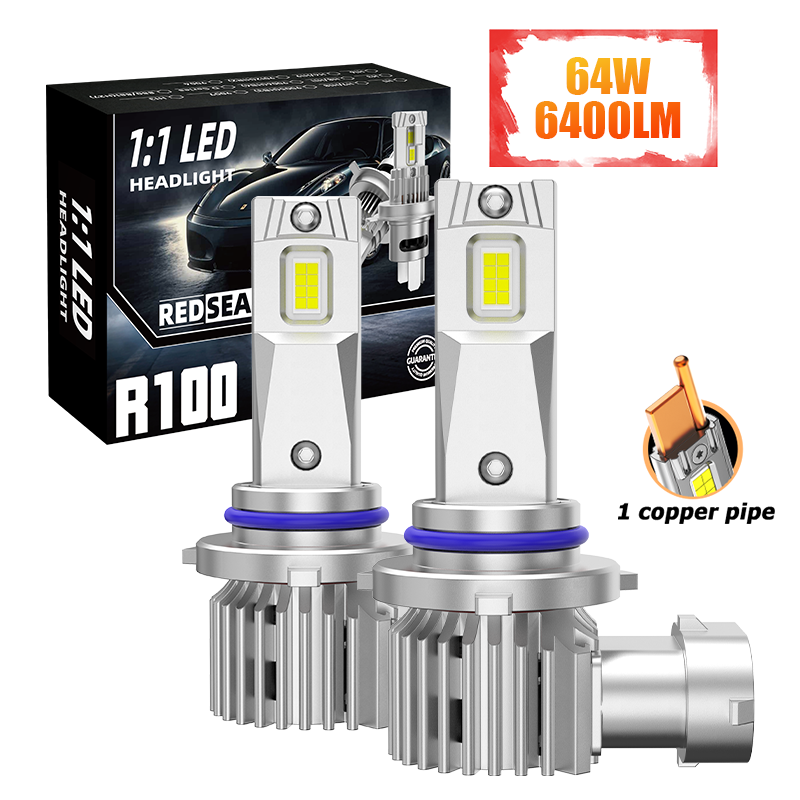
The Redsea R200 is engineered as an accessible, direct-fit replacement option for factory halogen bulbs, striking a practical balance between compact physical dimensions, electrical stability, and cost-effective volume manufacturing. Designed specifically to eliminate bulky external drivers and tangled wiring harnesses, the R200 delivers 1:1 plug-and-play installation inside compact headlamp housings.
• Rated Power & Luminous Output: 64W per pair (32W per bulb) delivering 6,400 raw lumens of 6500K daylight white illumination, providing an immediate visibility upgrade over standard 55W halogen bulbs.
• Optical Chip Architecture: Equipped with 8-Core 3570 CSP optical LED chips. The miniature emitting surface precisely mirrors the position and dimensions of an OEM tungsten coil, producing a clean, well-defined low-beam cutoff line with minimal stray light.
• Thermal Management & Construction: Machined from high-conductivity aviation-grade aluminum with integrated cooling fins, a pure copper thermal conduction plate directly beneath the chip substrate, and a high-speed silent cooling fan.
• H7 and H11 Socket Precision: In H7 format, the R200 features a stamped metal PX26d collar with straight spade pins designed for standard spring-clip retention; in H11 format, it incorporates a precision-molded PGJ19-2 base with an oil-resistant red silicone O-ring, ensuring airtight, watertight sealing in low-beam and bumper fog lamp applications.
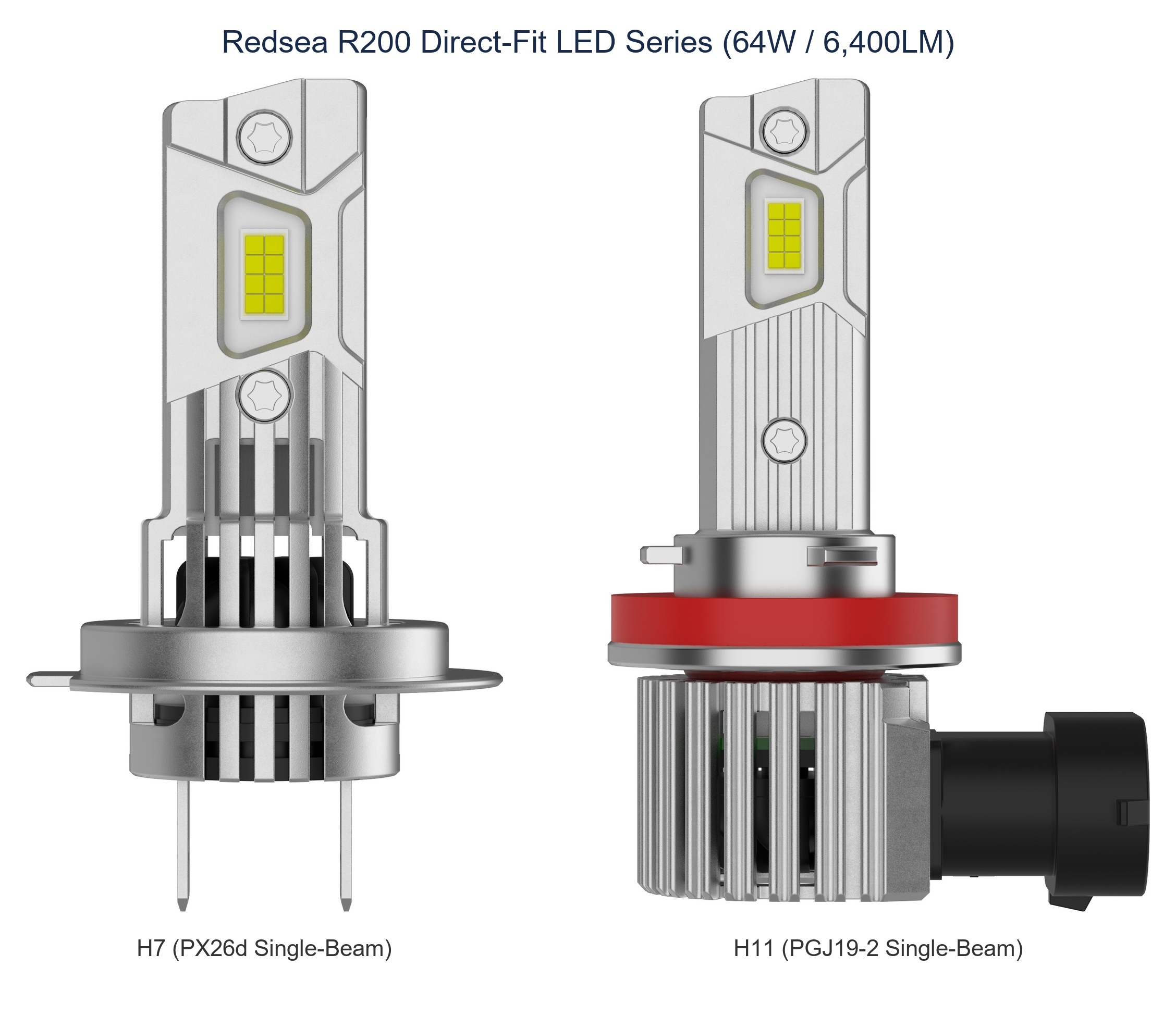
Figure 3: Redsea R200 Direct-Fit LED Headlight Series: H7 (Left) and H11 (Right) Side-by-Side Comparison.
For distributors and vehicle owners seeking increased optical intensity and a distinctive appearance, the Redsea R300 provides an upgraded 80W per pair and 8,000 lumens. Finished in an elegant champagne-gold anodized body, the R300 delivers substantial performance headroom while serving as an effective differentiated product line for overseas retail shelves and specialized distributor catalogs.
• Rated Power & Luminous Output: 80W per pair (40W per bulb) outputting 8,000 lumens at 6500K diamond white, broadening peripheral road coverage and center-lux road throw.
• Upgraded Chip Architecture: Upgrades to a 12-Core 3570 CSP high-density diode array — an approximate 50% increase in active chip emitting area compared to standard 8-core configurations. This delivers denser, more uniform light distribution across both reflector and projector optical bowls.
• Enhanced Thermal Dissipation: Engineered with a high-purity copper core heat plate, high-density champagne-gold aluminum dissipation fins, and an active micro-fan, ensuring dependable lumen maintenance without rapid thermal drop-off during prolonged nighttime driving.
• H7 and H11 Socket Precision: The R300 H7 integrates an ultra-thin collar design ensuring seamless latching with standard wire bails and aftermarket twist adapters; the R300 H11 features reinforced locking tabs and a heavy-duty silicone seal ring, delivering IP68 all-weather reliability against rain, mud, and road wash.
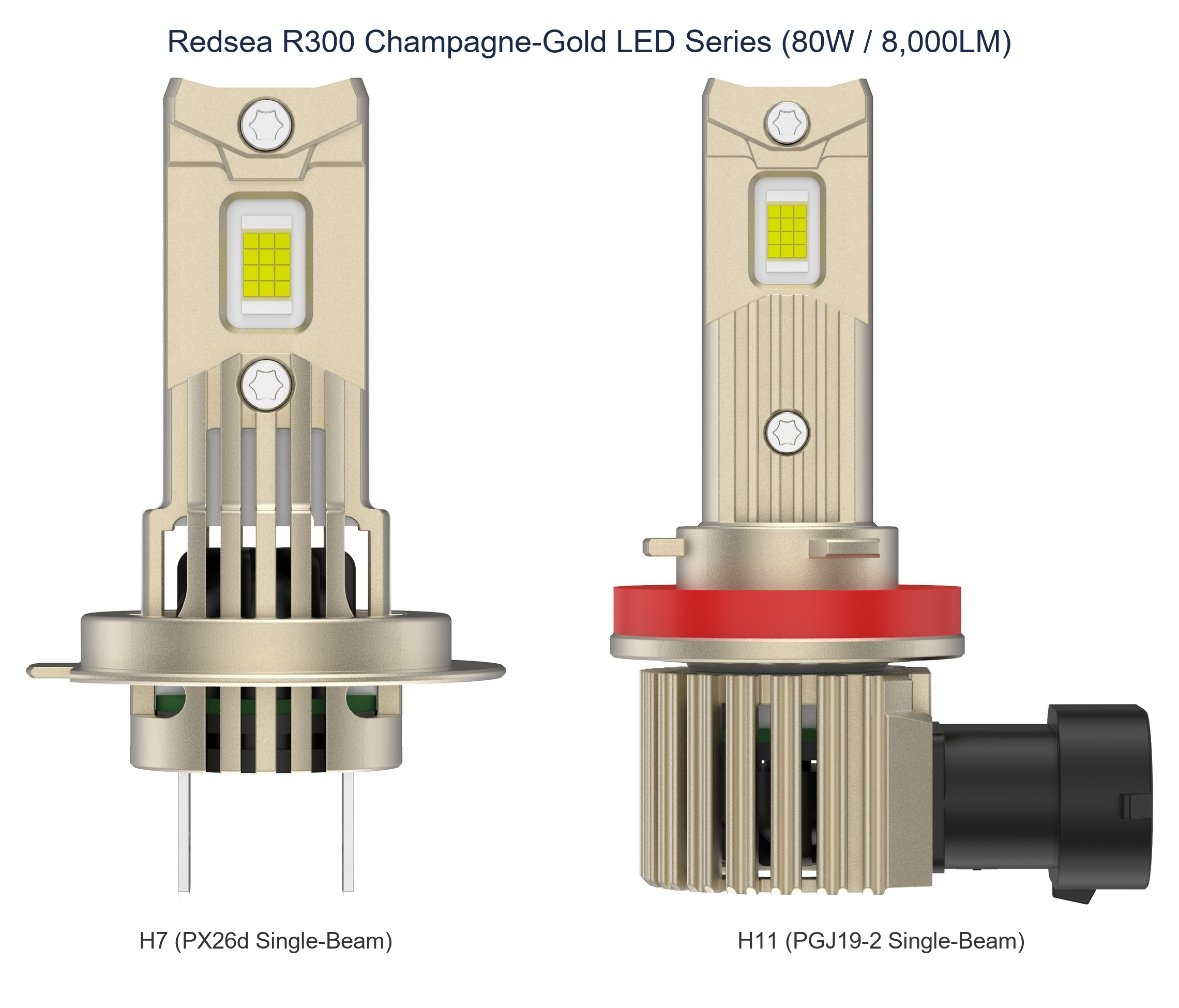
Figure 4: Redsea R300 Champagne-Gold High-Output LED Series: H7 (Left) and H11 (Right) Side-by-Side Comparison.
Automotive lighting is subject to rigorous safety regulations across major global markets. Manufacturers, wholesale distributors, and automotive retail professionals must operate with complete transparency regarding legal requirements and road-use approval.
|
IMPORTANT REGULATORY & ROAD-LEGAL DISCLAIMER (ECE R37 / DOT) • European Union & ECE Jurisdiction (UN-ECE R37-LEDr / E-Mark): Under United Nations Economic Commission for Europe regulations (ECE R37, ECE R48, and ECE R112), headlamp optical units in EU member states are type-approved exclusively with standard halogen light sources unless explicitly certified as LED replacement light sources (LEDr). Aftermarket LED retrofit bulbs that do not possess specific ECE R37-LEDr approval (E-mark approval for road traffic) are NOT certified for general, unrestricted use on public roads in European countries. • Permitted Operational Scenarios: Unless a vehicle has passed specific national type-approval testing (such as individual German KBA/TÜV vehicle compatibility approvals) or the bulb carries official ECE R37-LEDr certification, non-E-marked LED retrofit bulbs are designated solely for: (a) Off-road use (e.g., agricultural, industrial, or forestry vehicles); (b) Racing, track, rally, and closed-circuit competition; and (c) Private exhibition or show car use. • Distributor & Retailer Compliance Obligation: Importers, wholesalers, and retail distributors are legally responsible for verifying local road-traffic legislation (including US DOT / FMVSS-108, EU national highway codes, and regional inspection requirements) prior to marketing. Distributors must clearly advise end-consumers regarding the operational scope of retrofit LED bulbs in their respective jurisdictions. |
Notice 1: International Automotive Lighting Regulatory Notice & Road-Use Disclaimer.
Before purchasing replacement bulbs or importing container-load inventory for wholesale distribution, verify these four essential checkpoints:
• Verify Your Vehicle's Owner Manual: Never guess bulb sizes based on exterior headlamp shape. Always consult the official vehicle manual or remove the existing bulb to inspect the stamped marking on the metal flange (e.g., 'H7 12V 55W' or 'H11 12V 55W').
• Inspect Headlamp Housing Depth: LED bulbs feature integrated cooling assemblies at the base. Ensure there is at least 30mm to 40mm of clearance between the bulb collar and the headlamp dust cap for unimpeded cooling airflow.
• Confirm Clip Retainer Compatibility: Certain European H7 vehicles (such as VW Golf, BMW E46/E90, Mercedes W204) use proprietary plastic twist-retainers instead of standard wire springs. Reliable manufacturers provide custom adapter rings to enable clean, direct installation.
• Verify Local Regulatory Approvals: Confirm with your supply chain partner whether products intended for public highway use in specific jurisdictions hold necessary E-mark / ECE R37 certifications, or ensure appropriate off-road packaging labeling is in place.
While H7 and H11 bulbs share single-beam functionality and 55W halogen heritage, their distinct base geometries (PX26d vs. PGJ19-2), retention mechanisms, wiring pinouts, and weather-sealing environments make them fundamentally unique. Selecting the correct bulb is vital for vehicle safety, electrical integrity, and dependable road illumination.
With advanced LED manufacturing, proprietary copper plate thermal dissipation, and ultra-compact direct-fit architectures, Redsea's R200 and R300 series provide reliable, competitive, and accessible options for international distributors and automotive lighting professionals worldwide.
| Company Profile Parameter | Dongguan Red Sea Technology Development Co., Ltd. |
| Manufacturer Identity | Dongguan Red Sea Technology Development Co., Ltd. |
| Manufacturing Facility | 3,000 m² Modern Plant | 50+ Technicians | Daily Capacity: 3,000 Sets | Raw Stock: 60,000 Sets |
| Certifications & Testing | CE, RoHS, FCC, SAE, IP68 Factory Certified | 100% Full-Inspection Power-On Aging Protocols |
| Factory Address | Room 501, Building 1, No. 8 Chuangyi East Road, Daojiao Town, Dongguan City, Guangdong Province, China |
| Official Inquiries | Website: www.redseaheadlight.com | Email: [email protected] | OEM & ODM Support |
Table 2: Official Factory Credentials & Global Sourcing Inquiries.

Dongguan Red Sea Technology Development Co., Ltd. provides premium LED car headlights, BI-LED & laser lenses for global automotive brands. 15+ years OEM/ODM expertise, strict QC, 2000+ distributors. Contact us today!
Room 501, Building 1, No. 8 Chuangyi East Road, Daojiao Town, Dongguan City, Guangdong Province,523000
Copyright © 2026 by Dongguan Red Sea Technology Development Co., Ltd. Privacy Policy

 Hot News