
 EN
EN
Understanding Urban Road Lighting Needs for LED Car Head Lights
Driving in urban areas means dealing with frequent streetlights, complex road conditions, mixed traffic, and strict local traffic regulations about vehicle lighting. Unlike rural or highway scenarios where ultra-high brightness is essential for long-distance visibility, urban roads require balanced brightness for led car head lights—bright enough to ensure safe vision but not so intense that it causes glare to oncoming drivers, pedestrians, or cyclists.
Urban driving typically involves speeds under 60 km/h, frequent stops, intersections, sidewalks, and reflective road signs. Overly powerful led car head lights can create excessive glare, violate local lighting laws, and even lead to safety hazards or fines. Meanwhile, insufficient brightness fails to illuminate potholes, curbs, or sudden obstacles in time. The right brightness level keeps you visible, maintains road courtesy, and complies with urban driving norms.
REDSEA, a professional led car head lights manufacturer since 2010, designs its lighting products to match real-world urban driving scenarios, combining practical brightness, stable heat dissipation, and anti-glare performance for daily city use.
Safe Brightness Range for Urban LED Car Head Lights
For urban road use, the ideal brightness for led car head lights falls within a moderate, controllable range that balances illumination and glare control. Based on industry standards and REDSEA’s product data, the safe and practical lumen output for urban driving is 8,000–20,000 lumens, paired with power ratings from 64W to 200W.
This range is bright enough to light up the road 30–50 meters ahead—sufficient for urban speed limits and reactive driving—without producing harsh glare. REDSEA’s R200 and R300 led car head lights are built exactly for this purpose: the R200 offers 6,400LM at 64W, and the R300 provides 8,000LM at 80W. Both use halogen 1:1 size, plug-and-play wireless design, Super Canbus, and waterproof construction, making them ideal for steady, glare-free urban illumination.
Higher-power models like REDSEA’s R33 (330W, 33,000LM) and R40 (330W, 33,000LM) are designed for off-road, rural, or commercial vehicles, not standard urban passenger cars. Using these ultra-bright options in cities often causes glare pollution and may break local vehicle lighting rules.
Key Factors Beyond Brightness for Urban LED Car Head Lights
Brightness alone does not define good urban led car head lights; heat dissipation, beam pattern, and anti-glare design are equally critical. Urban driving involves frequent start-stop cycles, so led car head lights must maintain stable brightness without overheating or dimming over time.
REDSEA’s urban-suitable led car head lights use reliable heat dissipation structures: some models include dual copper pipes, and high-power versions use three copper pipes to quickly lower working temperature. This design keeps brightness consistent and extends service life, supporting the 12–24 month warranty provided by the manufacturer.
A well-cut light pattern is also vital. Good led car head lights spread light evenly across the road without upward scattering that blinds oncoming drivers. REDSEA’s products feature optimized optical structures to focus light downward and forward, complying with CE, RoHS, and ISO certification requirements for safe urban use.
Matching REDSEA Products to Urban Driving Scenarios
Choosing the right REDSEA led car head lights for urban areas means selecting models that match daily commuting, city cruising, and night driving in well-lit neighborhoods.
- For daily city commuting: REDSEA R200 (64W, 6,400LM) and R300 (80W, 8,000LM) are the best choices. Their 1:1 halogen size, plug-and-play installation, Super Canbus compatibility, and waterproof rating make them easy to use and stable in all urban weather.
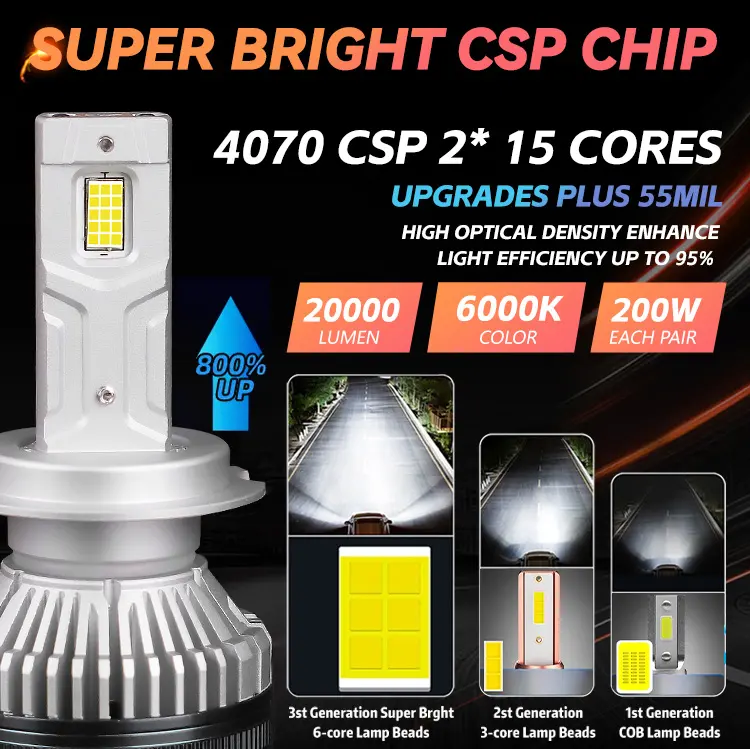
- For occasional suburban-urban mixed driving: REDSEA R20B (200W) with 4575 CSP chips and dual copper pipes offers stronger brightness while remaining glare-controlled for light urban use.
Ultra-high-power models like R33 and R40 are not recommended for regular urban roads, as their 33,000LM output exceeds typical urban lighting limits and increases glare risk.
How to Choose and Use LED Car Head Lights Correctly in Cities
To use led car head lights properly in urban areas, follow these practical tips to stay safe and courteous:
- Stick to the 6,400–8,000LM range for daily city driving, matching REDSEA R200 or R300 specifications.
- Avoid installing off-road-spec led car head lights on urban passenger vehicles to prevent glare and legal issues.
- Ensure your lights have a clear low-beam/high-beam switch; use low beams in downtown, residential, and well-lit areas.
- Choose certified products with reliable heat dissipation to maintain steady brightness and long-term durability.
- Follow local vehicle lighting regulations to avoid penalties and ensure road safety for everyone.
REDSEA supports OEM/ODM customization for led car head lights, allowing you to adjust brightness, appearance, and packaging to fit regional urban driving standards, with a defect rate below 1% and full inventory for fast worldwide shipping.
Conclusion
The most suitable brightness for led car head lights in urban areas is moderate, glare-controlled, and scenario-matched, not blindly high. For most city drivers, 6,400–8,000 lumens (64W–80W) provides safe, legal, and considerate illumination. REDSEA’s R200 and R300 series are purpose-built for this demand, combining stable performance, efficient heat dissipation, and user-friendly design to make urban night driving safer and more comfortable.
When choosing led car head lights, prioritize real urban driving needs over maximum brightness figures. The right lighting protects you, respects other road users, and keeps your journey compliant and secure.
Table of Contents
- Understanding Urban Road Lighting Needs for LED Car Head Lights
- Safe Brightness Range for Urban LED Car Head Lights
- Key Factors Beyond Brightness for Urban LED Car Head Lights
- Matching REDSEA Products to Urban Driving Scenarios
- How to Choose and Use LED Car Head Lights Correctly in Cities
- Conclusion