
 EN
EN
Upgrading your car’s halogen headlights to LED is one of the most effective improvements you can make—better visibility, lower energy draw, and a much longer lifespan. But picking the right headlight bulb led isn’t just about grabbing the brightest option on the shelf. Different car brands have different lighting architectures, bulb bases, and electrical behaviors. A bulb that works perfectly in a Toyota might trigger dashboard errors in a Volkswagen or create blinding glare in a BMW. This guide walks you through how to match LED bulbs to your specific vehicle, drawing on real-world installation experience and industry best practices.
Understand the Key Technical Parameters Before You Buy
Before diving into brand-specific recommendations, you need to understand the three core specifications that determine whether a headlight bulb led will perform well in your car. The first is bulb base type—common halogen-to-LED upgrade bases include H4 (dual-beam, one bulb handles both high and low beams), H7 (single-beam, used for either low or high beam), H11 (commonly used for low beams and fog lights), and 9005/9006 (often paired together, with 9005 for high beams and 9006 for low beams). Many modern vehicles from Toyota, Honda, Nissan, and Chevrolet use the H11/9005 combination, while older Asian and European models frequently use H4 or H7.
The second parameter is color temperature, measured in Kelvin (K). The sweet spot for automotive headlights is 5000K–6500K, which produces a crisp white light that maximizes road contrast without the harsh blue tint of higher-K bulbs. The third parameter is heat dissipation. LED chips generate concentrated heat, and without proper cooling—either through braided copper heat sinks or active cooling fans—the bulb will experience thermal degradation, leading to premature dimming and failure.
Always Verify Your Car’s Specific Bulb Socket Type
This is where many first-time upgraders make a mistake. You cannot simply assume your car uses the same bulb type as someone else’s. Even within the same brand and model, different trim levels and model years may use different bulb configurations. For example, the 2014 Nissan Altima uses H11 for low beams and 9005 for high beams. A 2015 Honda CR-V follows the same H11/9005 pattern, with H11 for low beams and 9005 for high beams. The 2009 Toyota Camry also takes H11 for low beams and 9005 for high beams. On the other hand, many Volkswagen models—such as the 2020 Tiguan—use H7 for low beams and 9005 for high beams, with H11 for fog lights.
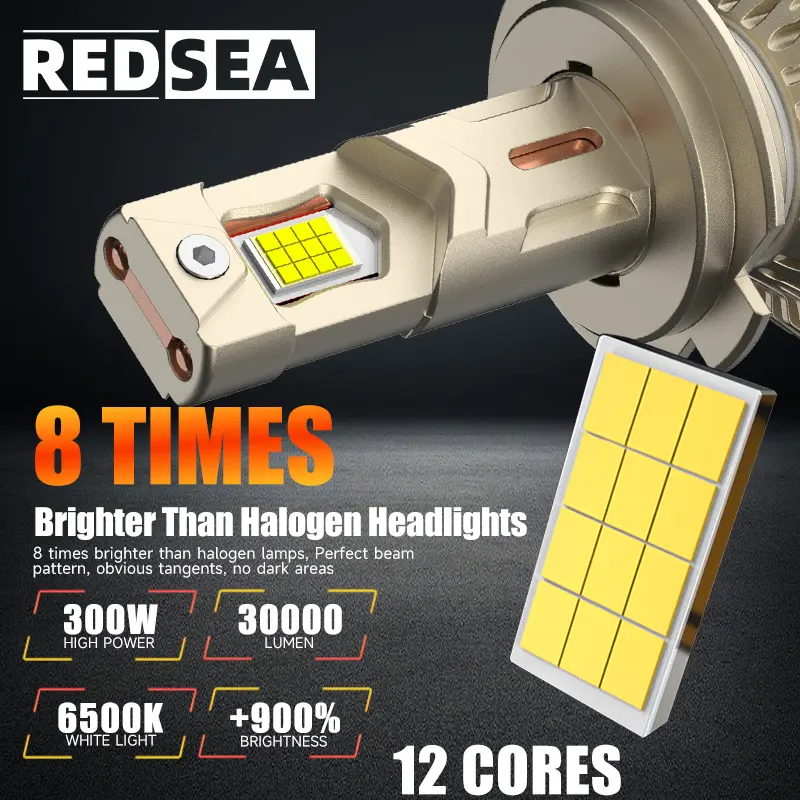
The safest approach is to check your vehicle owner’s manual, look at your existing halogen bulb (it will have the type printed on the base), or use an online bulb finder tool. Once you confirm the base type, you can confidently select an LED bulb that physically fits your headlight housing. Manufacturers like REDSEA offer a wide range of headlight bulb led options covering the most common bases—H4, H7, H11, 9005, 9006, and others—ensuring you can find a direct fit for your specific vehicle.
Address Brand-Specific Compatibility Challenges
Different car brands present unique challenges when upgrading to LED. Here are the most common issues you need to watch for:
European Brands (BMW, Mercedes-Benz, Audi, Volkswagen). European vehicles often have the most sensitive CANbus electrical systems. When you replace a halogen bulb (typically 55W) with an LED bulb (often 25W–40W), the vehicle’s computer detects the lower power draw and interprets it as a “bulb out” condition, triggering dashboard error messages or causing the headlights to flicker. To resolve this, you need either a CANbus-ready LED bulb with built-in error cancellation or an external decoder module. Many European cars also have narrower headlight housings and tighter dust caps, so choosing a compact LED bulb with a small driver box is essential for physical fitment.
Asian Brands (Toyota, Honda, Nissan, Hyundai, Kia). Asian vehicles are generally more forgiving with LED upgrades. They use standard bulb bases and are less prone to CANbus errors. However, you still need to pay attention to beam pattern alignment. Many Asian cars use reflector-type headlight housings rather than projector lenses. In reflector housings, the bulb’s light source position must precisely match the halogen filament position to avoid scattering light and creating glare for oncoming traffic. A high-quality LED bulb with 1:1 filament positioning technology—where the LED chips are placed exactly where the halogen filament originally sat—will produce a clean cutoff line and proper beam pattern.
American Brands (Ford, Chevrolet, Dodge). American vehicles are typically straightforward to upgrade, with robust electrical systems that accept LED bulbs without frequent error codes. The most common base pairings are H11/9005 for Chevrolet and Ford trucks and SUVs, and H7/9006 for various Ford sedan models. For many Chevy Silverado and Ford F-Series owners, a direct plug-and-play LED replacement is entirely feasible.
Don’t Overlook Heat Management and Physical Fitment
Two practical considerations often get overlooked. The first is heat management. High-quality LED bulbs generate significant heat that must be dissipated to maintain performance and longevity. Active cooling fans are effective but can fail over time and may produce audible noise. Passive cooling systems using copper braids or aluminum heat sinks are silent and more durable but require adequate airflow inside the headlight housing. The second consideration is physical space. LED bulbs are often longer than halogen bulbs due to the heat sink or fan assembly at the base. Before purchasing, check whether your headlight housing has enough depth and whether the dust cap can be reinstalled. Some vehicles require aftermarket extended dust caps to accommodate the extra length of LED bulbs.
Verify Your Vehicle’s Headlight Housing Type
Finally, understanding your headlight housing type is critical for achieving proper beam performance. Vehicles equipped with projector housings (a lens that focuses light into a sharp beam) generally perform better with LED upgrades because the projector lens controls the light output and creates a clean cutoff line. Vehicles with reflector housings rely on the precise positioning of the light source to aim the beam correctly. When upgrading a reflector housing to LED, choose a bulb specifically designed to mimic the halogen filament’s position. Many reputable LED manufacturers now offer bulbs with adjustable beam pattern collars that allow you to rotate the LED chips into the optimal orientation, ensuring the high beam points where it should and the low beam creates a clear horizontal cutoff.