EN
EN
Quick Links
Headlights are the eyes of your car, safeguarding your safety by illuminating the road ahead in low-light or poor-visibility conditions. Whether you’re driving at night, navigating through heavy rain, or pushing through fog, the quality of your headlights directly impacts your ability to see clearly and react promptly. Today, there are four main types of headlights every driver should be familiar with: halogen headlights, HID (xenon) headlights, LED headlights, and laser headlights. Each type boasts distinct strengths in terms of brightness, energy efficiency, lifespan, and cost.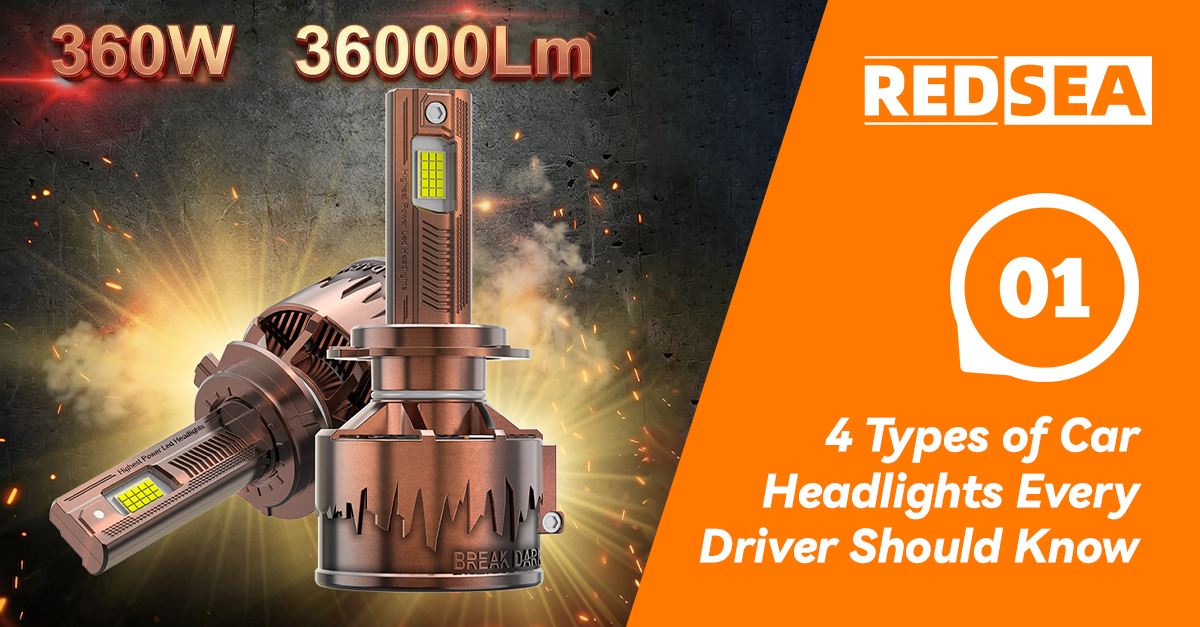
In this guide, we’ll take an in-depth look at these four headlight technologies, explaining how each one works, their key advantages, and potential drawbacks—so you can make an informed decision when it’s time to upgrade or replace your vehicle’s headlights.
1. Halogen Headlights – The Traditional Standard
How They Work
Halogen headlights are the oldest type of modern car lights, essentially an evolution of the traditional incandescent bulb. They operate by passing electricity through a tungsten filament inside a bulb filled with halogen gas. The filament heats up to approximately 2,500°C, emitting light in the process. The halogen gas enables the filament to burn hotter and last longer than standard incandescent bulbs, making it a more reliable option for automotive use.
Key Features
Halogen bulbs typically produce a warm yellowish light with a color temperature of around 3,200K. Their light output is relatively modest, ranging from 700 to 1,200 lumens, and their luminous efficiency is only about 5–10 lm/W—meaning most of the energy they consume is converted into heat rather than usable light. A typical halogen bulb consumes 55W to 65W of power and has a lifespan of roughly 500 to 1,000 hours.
Pros
Cons
Who Should Choose Halogen?
Halogen headlights are ideal for drivers on a tight budget or those with older vehicles who only need a low-cost replacement. However, for anyone seeking better nighttime visibility, improved safety, or long-term cost savings, upgrading to a more modern headlight technology is highly recommended.
2. HID (Xenon) Headlights – The High-Intensity Discharge Option
How They Work
HID headlights, also known as xenon headlights, produce light by creating an electrical arc between two electrodes inside a tube filled with xenon gas and other rare gases. Unlike halogen bulbs, which rely on a glowing filament, HIDs have no filament to burn out. Instead, a ballast delivers a high-voltage surge to ignite the arc, which then sustains itself at a lower voltage for continuous operation.
Key Features
HID headlights emit a bright, white light with a color temperature typically ranging from 4,000K to 6,000K. Their light output reaches 3,000–5,000 lumens, with a luminous efficiency of 25–35 lm/W—significantly higher than halogen bulbs. HID bulbs typically last around 2,000 to 3,000 hours and consume 35W to 50W of power, making them more energy-efficient than halogen.
Pros
Cons
Who Should Choose HID?
HID headlights were popular in the 2000s and early 2010s, and they remain a viable option for drivers who frequently drive on dark rural roads at night and want a wide, bright beam. However, for most drivers today, LED technology offers better overall value, with comparable brightness, longer lifespan, and simpler installation.
3. LED Headlights – The Modern Leader
How They Work
Light Emitting Diode (LED) headlights use advanced semiconductor technology to produce light directly. When an electrical current passes through a semiconductor material, electrons release energy in the form of photons—generating light instantly. Unlike halogen or HID bulbs, LEDs contain no filament to burn out and no gas to leak, making them more durable and reliable.
Key Features
LED headlights are now the mainstream trend in automotive lighting, widely used from economy cars to luxury vehicles. They typically produce a pure white light with a color temperature between 5,000K and 6,000K, closely matching natural daylight for reduced eye fatigue. Brightness can exceed 4,000 lumens per bulb, with some high-performance models reaching 6,000+ lumens. LEDs consume only about 20W to 40W per bulb—roughly one-third of a halogen light—and can last up to 50,000 hours, nearly the entire lifetime of most vehicles.
Key Advantages
Potential Drawbacks
Pros Summary
Cons Summary
Who Should Choose LED?
For the vast majority of drivers, LED headlights offer the best balance of brightness, lifespan, energy efficiency, and overall value. Whether you drive a compact sedan for daily commuting, a pickup truck for weekend adventures, or an electric vehicle for eco-friendly travel, upgrading to quality LED headlights is one of the most effective ways to improve nighttime driving safety and reduce long-term maintenance costs.
4. Laser Headlights – The Future of Automotive Lighting
How They Work
Laser headlights represent the cutting edge of automotive lighting technology. Instead of using a filament, arc, or standard LED chip, laser headlights use laser diodes to excite a phosphor material, which then emits a highly intense, focused beam of white light. Unlike laser pointers that project a concentrated, potentially harmful beam, automotive laser headlights use a phosphor converter to create safe, diffuse illumination that is gentle on the eyes.
Key Features
Laser headlights are currently found only on high-end luxury vehicles from brands like BMW and Audi, such as the BMW i8 and Audi A8. They produce an extremely bright white light exceeding 6,000 lumens, with a lighting distance of up to 600 meters—twice that of LED lights. Their compact size allows for even more flexibility in headlight design, and their energy conversion efficiency is about 30% higher than LEDs.
Advanced laser headlight systems can dynamically adjust beam patterns to suit different driving conditions. For example, when driving at low speeds, the system spreads the light for better peripheral illumination; at high speeds (above 70 km/h), it concentrates the beam for maximum distance. Audi has announced plans to make matrix laser headlights available on more affordable models in the coming years, making this technology more accessible.
Pros
Cons
Who Should Choose Laser?
For most drivers, laser headlights remain out of reach due to their high cost and limited availability. However, they represent the future direction of automotive lighting, and as the technology matures and costs decrease, we can expect to see them on a wider range of vehicles in the years ahead. For now, they are best suited for luxury car owners who prioritize cutting-edge performance and are willing to invest in premium features.
Comparison of 4 Types of Headlight Features
| Feature | Halogen | HID (Xenon) | LED | Laser |
| Brightness | Low (700–1,200 lm) | Medium-High (3,000–5,000 lm) | High (4,000–6,000+ lm) | Very High (6,000+ lm) |
| Lighting Distance | Short (~100m) | Medium (~200–300m) | Long (~400–500m) | Very Long (~600m) |
| Lifespan | Short (500–1,000 hrs) | Medium (2,000–3,000 hrs) | Long (30,000–50,000+ hrs) | Long (50,000+ hrs) |
| Energy Consumption | High (55W–65W) | Medium (35W–50W) | Low (20W–40W) | Very Low |
| Color Temperature | Warm (~3,200K) | White/Blue (4,000–6,000K) | Pure White (5,000–6,000K) | Pure White |
| Cost | Low | Medium-High | Medium | Very High |
| Best For | Budget-conscious, older vehicles | Rural night driving | Most drivers — best all-rounder | Premium luxury cars |
Which Headlight Is Right for You?
There’s no single “best” headlight for every driver—it really depends on your driving needs, budget, and vehicle type.
Beyond the type itself, remember that beam pattern and optical design matter just as much as the light source. Even the best LEDs can underperform if poorly designed, while a well-tuned headlight system ensures clear, even lighting without dark spots or glare—keeping you and other road users safe.
Why Choose REDSEA LED Headlights?
At REDSEA, we focus on delivering LED headlights that combine brightness, efficiency, and long-lasting performance. Our team puts great effort into research and development to ensure every product meets real driving needs, with a focus on safety, reliability, and ease of use.
What Sets REDSEA Apart?
We Also Provide
Light up the road ahead—choose REDSEA.
 Hot News
Dongguan Red Sea Technology Development Co., Ltd. provides premium LED car headlights, BI-LED & laser lenses for global automotive brands. 15+ years OEM/ODM expertise, strict QC, 2000+ distributors. Contact us today!
Room 501, Building 1, No. 8 Chuangyi East Road, Daojiao Town, Dongguan City, Guangdong Province,523000
Copyright © 2026 by Dongguan Red Sea Technology Development Co., Ltd. Privacy Policy